

Table of Contents
Section 1 – Story, Mission, Basics & Team
1a. Story
Axon is a fascinating company. It was founded 33 years ago by its current CEO – Rick Smith – after two of his friends tragically passed away in a road rage incident. Smith’s sorrow sparked an intense energy within him that morphed into motivation for inspiring change. He then dedicated his career to the initial Axon goal of providing better public safety tools to keep the world safe. He wanted to equip everyone with tools to safely de-escalate, rather than lethally injure. His answer? Tweaking and popularizing the Taser. 33 years later, Axon is a $50B company where he’s still CEO.
Axon, which was called The Taser Company until 2017, did not invent this hardware, but it did change the design and go-to-market strategies that led to its broad proliferation. The inventor was actually Jack Cover, a NASA scientist who used gunpowder to shoot the canisters. That decision meant Tasers were regulated like any other firearm and prevented meaningful traction. Smith sought to find a loophole that wasn’t legally treated this strictly and enabled more relaxed restrictions. He knew this technology could be an invaluable asset without needing deadly force. Together, Smith & Cover redesigned the Taser to use compressed nitrogen instead of gunpowder, which unlocked its use for civilians without a gun permit.
- Fun fact: Taser is actually TASER. It's an acronym that stands for Thomas A. Swift's Electric Rifle. Cover named it after his favorite book character growing up.
Interestingly, Smith and Axon initially focused on the consumer market and found very little success. Because of this, the company was on the brink of bankruptcy throughout its early years, even relying on the family to plug liquidity gaps and avoid shutting down in 1994. Like any generational founder, Smith dug in. He bobbed, weaved, contemplated and clawed until Axon finally found the product and go-to-market strategy that drove its success. The change? Pivoting to a focus on state and local law enforcement, which became Axon’s primary growth driver for decades and is still its bread and butter today – with plenty of runway remaining. Early on, he even made himself a public test dummy in a famous marketing stunt to convince customers of this product’s value (& non-lethal incapacitation). He was and is all in.
As we’ll learn throughout this piece, Axon is now the global Taser leader by a mile. It has leveraged this great success to expand into several product categories that round out its positioning as a holistic, central operating system for its customers. Over the last few decades, they’ve carefully built a large and connected product platform well beyond the Taser to cater to a wide range of public safety needs.
Their increasingly platform-wide pursuit is why they’re now called Axon, as this refers to nerve fibers that connect the human brain and foster movement. Axon wants to be the company to connect public safety workflows, departments and systems into one collaborative force for enhanced security. This goes for both hardware and software, with Evidence.com (Axon Evidence) marking its software debut 18 years ago. And as we’ll see throughout the piece, the magic of Axon is offering this better safety while also generating meaningful cost and labor savings for law enforcement customers.
1b. Culture
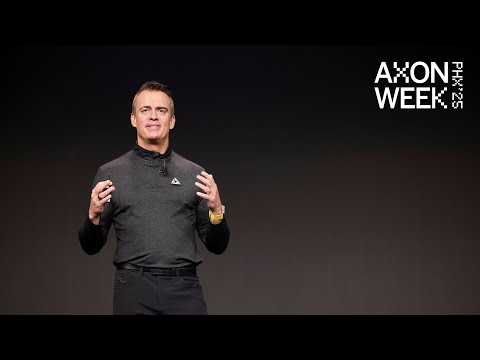
The founder-led culture can be described as responsibly ambitious. They’re a bunch of friendly yet maniacally focused sci-fi nerds, as evidenced by Smith rocking his Star Trek-themed attire at the most recent investor day. They host grand events that resemble Berkshire Hathaway or Dreamforce, yet do so only if they can generate enough sales pipeline to make them worthwhile for shareholders. They take innovation and growth very seriously, but have strict guardrails in place to ensure stakeholders are still cared for.
Management is also exceedingly competitive. They are driven to outspend, out-hire and out-innovate the competitive landscape. They will openly criticize themselves when they think they can do better, and show a consistent ability to quickly fix any operational issues as they pop up. For example, the company was quite blunt about a disappointing start to bookings in 2024. They said they weren’t focused or proactive enough in sales motions (despite what was a pretty good quarter), and fixed that for Q1 2025, delivering bookings momentum that surpassed expectations and set them up for a great year. Some companies will search for any excuse they can to explain bad results. Others, like Axon, overcome very real headwinds and execute. They can’t stand losing and are obsessively determined to beat everyone.
Axon’s leadership is wonderfully paranoid, constantly looking over their collective shoulders and searching for new threats to address. They are allergic to complacency despite holding dominant positions across several product categories. That starts and ends with CEO Rick Smith and extends to every corner of Axon’s operations. Simply put, this company is a lean, mean fighting machine focused on the right things and led by the right people. And they don’t want us to rely on their internal opinions. They want stakeholders to hold them accountable to their abstract goal of improving public safety by setting a concrete target of cutting police-related deaths in half by 2032. They won’t declare a win unless it’s objective and they’re energized by all the tools they have to secure that sweet, sweet victory. We’ll dig into all of that throughout the piece.
1c. Team
Rick Smith’s resume is simply graduating from Harvard and founding Axon. One of his key priorities over the last handful of years has been building out the rest of his executive team. He wanted to deepen the bench of talent to confidently hand off day-to-day work so that he could focus on big growth opportunities and customer relationships. Axon’s President is Josh Isner. I love his background because it screams loyalty and alignment with the company mission and culture. Like Smith, he finished school at Harvard and immediately began climbing the ladder at Axon. 17 years later, he is running earnings calls and core Axon operations. He’s energetic on these calls and certainly a tad feisty, as he’s happy to remind a bearish analyst when their forecasts were way off during a Q&A.
The COO/CFO is Brittany Bagley. Ideally, I think a company of this size should have a separate person for each role, but this isn’t unprecedented by any means. Bagley was the CFO at Sonos for 5 years before this and was a Managing Director at KKR before that. The CTO and Chief Product Officer (CPO) is Jeff Kunins. He was just CPO for 4 years and added the CTO title in 2023. Before Axon, he was a VP of Alexa and Kindle at Amazon and a GM of Messenger and Social at Microsoft, among other things. Finally, Cameron Brooks was named the Chief Revenue Officer almost 2 years ago. He spent 6 years at AWS as the GM and Managing Director of their EMEA region and was a Director of key divisions at IBM like Watson. Internal employee surveys indicate strong employee support for leadership, and the company routinely earns “great place to work” accolades from various 3rd-party research organizations.
1d. Basic Business Model & Opportunity
Axon sells hardware like Tasers and body-worn cameras (BWCs) and software to form an end-to-end product suite. All products are bundled into various subscriptions, where hardware revenue is largely recognized upfront and software components over the course of the deal. 96% of its revenue is tied to active subscriptions, which, when paired with sky-high renewal rates, leads to great demand visibility. Recurring monthly subscription fees range from $99/month to $600/month. The firm loves to offer free trials to show off what it views as a superior offering, as these trials frequently close the sale. Like all good subscription-dominant companies, they’re fixated on elite price-to-value. They will not opportunistically take price at every turn and instead focus on improving product and customer value wherever possible. When (and only when) that leads to an overly aggressive price-to-value gap, they will take price. And? As a nod to the mission-critical nature of their platform, they’ve never dealt with material churn when doing so.
The Total Addressable Market (TAM) sits at an impressive $160B. They have so many growth levers at their disposal, while their most mature U.S. state and local law enforcement niche ($19B TAM) is just 15% penetrated. The 15% figure is before factoring in all of the product innovation and up-selling available to capture larger deals and more budget. And they’re already basically in every single one of these departments across the nation (about 17,000 of them), with cross-selling the biggest remaining driver of their growth. They already dominate. They’re already ubiquitous. For a sector like policing where vendor reputation and trust are especially important, that gives them the ability to win in other product categories. As we’ll explore later, they are doing just that.
Across its emerging enterprise ($48B), international ($78B), federal ($12B) and civilian ($5B), the company is in excellent shape in terms of finding more opportunities to drive sustainable, multi-year growth. They don’t need to reinvent the wheel to find more demand, as the highly relevant product adjacencies are bountiful.
In terms of broad categories, Axon splits its connected device revenue into Tasers, personal sensors (like BWCs) and platform solutions (like drones).
Section 2 – Connected Devices Product Category
2a. Sensor Army
Before we get into Axon’s various products, we need to talk about the sensors that augment their value. Without these tools, Axon’s value proposition would be far more limited. Its Taser and other offerings can provide a mountain of valuable data to improve processes and outcomes. To capitalize on this, the assets need to actually know when to start collecting that knowledge. And that’s where sensors come in.
The sensors are deeply embedded across its vehicles, officers, city infrastructure and community volunteer networks and tie very closely to these pieces of hardware. The sensor-to-hardware interoperability ensures that data collection reliably happens exactly as needed and greatly helps customers grasp more complete information to do their jobs better. These automatically jumpstart recordings, log weapon activity, activate first responders and more. Officers don’t need to remember to do all of this on their own while they work through dangerous and rapid situations. They can focus on doing their jobs in the field, knowing the sensor base will understand situations to a point of reliably and automatically activating cameras in real-time.
Considering all of this, Axon boasting the world’s largest connected sensor network means the high-fidelity context it delivers to its customers is unmatched. How do these sensors know when to start streaming footage? Through a series of triggers that can prompt these cameras to turn on. Types of triggers include:
- Heat thresholds.
- GPS locations.
- Alarms going off.
- Floor pressure or other motion detection.
- Voice and other acoustics (like glass breaking).
- Partner infrastructure triggers (like Ring Doorbells).
- Removing a weapon from a holster
The firm provides this wireless communication technology through a product called Axon Signal. Leadership will frequently call this the “eyes and ears” for everything else it does, and I think it’s clear why that is. The boatload of quality data its sensors provide turbocharged insight gleaning across its full ecosystem of products, helping sharpen things like drone response quality, vehicle identification and so much more. As we talk through every single product in this connected devices section, keep in mind that sensors accompany all of them and bring their maximum potential to life.
2b. Connected Devices – Tasers
It wouldn’t feel right to start the product portion of this deep dive with anything other than the Taser. This company owns 95% of the entire market and has a presence in virtually every single state and local police agency in the USA. And while Axon’s Taser has a decades-long history, it makes sense to focus this section on its newest Taser 10 model. It views this as a key unlock for less lethal policing and reaching its 2032 goal of cutting fatalities in half. In my mind, that opinion is the right one and is based on a few exciting technological upgrades that make the Taser a better option in more scenarios. Their goal is for this to be the de facto weapon of choice for officers instead of firearms, and this launch got them a lot closer to that objective. There are three main reasons why.
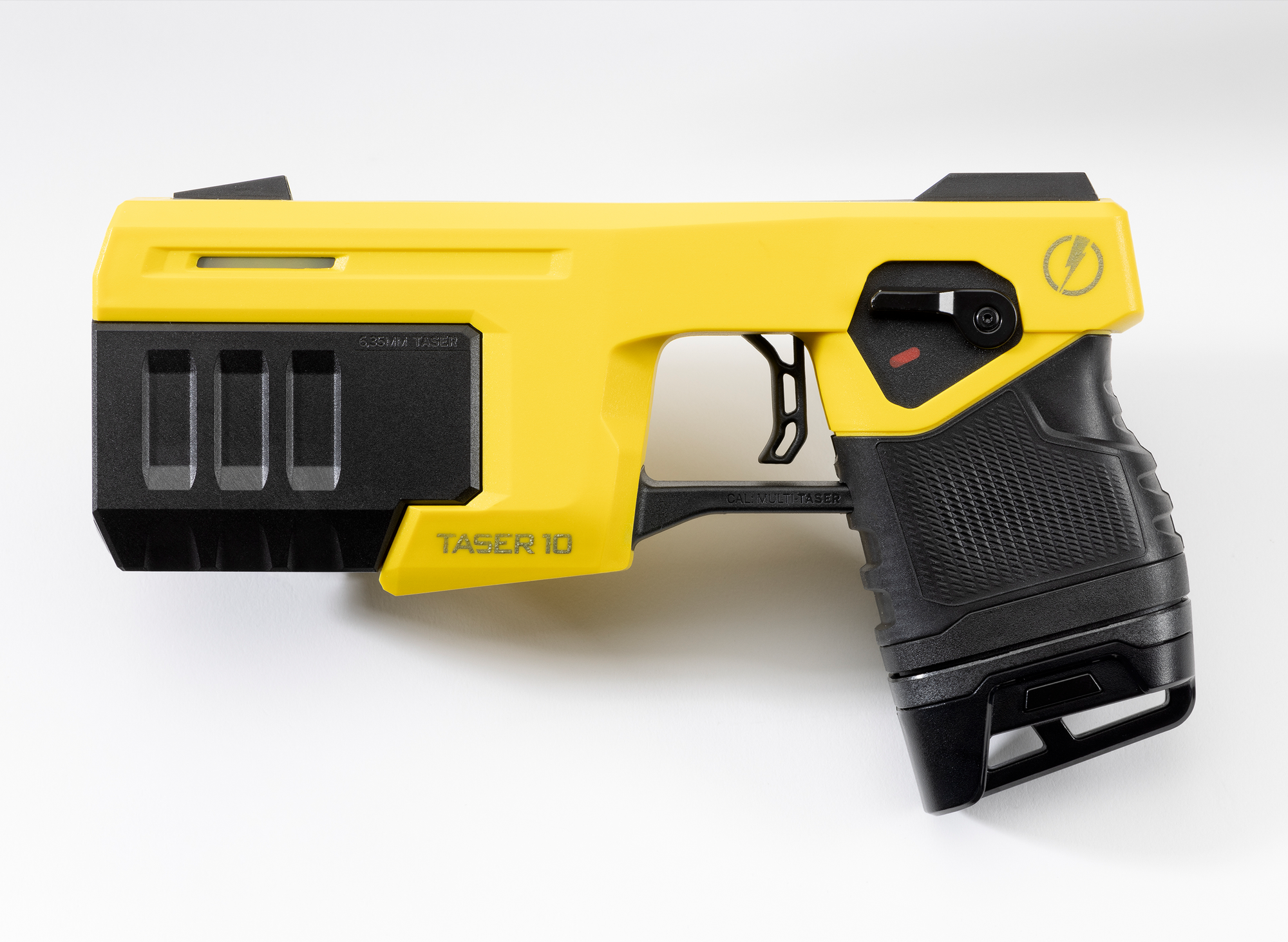
First, the Taser 10 model now holds 10 shots and 1 cartridge per shot. Previously, this hardware allowed for 2 shots and fired 2 cartridges at a time in order to work. As these move towards the target, they naturally spread and make accuracy rates much lower than a gun. That obviously makes officers more hesitant to select this option in high-stakes, rapidly evolving situations. With Taser 10, officers have more shots on goal and accuracy rates that can eclipse 90% with proper training vs. 65%-70% for previous models and even lower (national average around 35%) for guns.
The second major upgrade comes in the form of a near doubling in range. The previous model and its sub-scale competitors had 25 feet of range, while this has 45 feet. While that may sound subtle, it isn’t. In the policing world, it’s a game-changer. It means an officer deciding to use a Taser in high-stakes situations can now select this weapon before it’s nearly too late to actually use it. Officers need confidence that Tasers give them enough time to think through situations, as that can be the difference between life and death. They need to feel better about using this weapon in up-close confrontations or combat, and this range boost helps mightily in that regard. Not just that, but a Taser doesn’t jam if it’s pressed up against an officer's vest and it doesn’t take a life if fired at the wrong part of a suspect’s body. Both of those factors are clear benefits that a traditional firearm doesn’t match, which is important.
The third and last upgrade is still in beta testing but comes with so much promise. Axon will soon fully launch its upgraded “Apollo Cartridge.” Sticking with the wonderfully nerdy sci-fi culture theme, Apollo is moon-landing inspired. Why? Because Axon views its policing death reduction goal as a “moon shot” and believes this will be a big piece of it getting there. Why? Apollo solves a key Taser issue. Up until now, these weapons have been pretty useless in cold-weather climates with people wearing thick clothing. Tasers must be powerful enough to pierce the skin and not powerful enough to keep moving deeper thereafter. Otherwise, people will get seriously injured and the Taser utility drops. The Apollo cartridges rely on clothing and skin piercing differently. When the projectile cartridge feels penetration resistance change, it is designed to deploy flaps on the Taser spear to slow it down. This way, the weapon works if a suspect is wearing nothing or a winter coat. They will likely ramp Apollo production in the coming months, which will represent a key up-selling opportunity across their gigantic install base. Looking ahead, Apollo, more Tasers per department, upgrade momentum and key growth areas like international and corrections centers (more later) can fuel many more years of brisk compounding for its oldest product category. It’s still growing at a nearly 20% Y/Y clip decades after initial launch.
Despite all of these advantages, some officers still struggle to use the Taser effectively in the field. Knowing this, Axon has worked hard to standardize virtual reality (VR) training modules that simulate a plethora of real-life situations and boost concept retention by 45%. These modules can be perpetually accessed, making training more frequent than a typical annual session. They also look and feel like video games, effectively giving officers a more engaging way to learn. When customers deploy both VR and physical training, employ a Master Instructor and follow behavioral recommendations like firing until an adversary is controlled (very different than a gun), programs are routinely successful and strong traction ensues. Axon has worked very hard to communicate this playbook, and it has already had a material impact on Taser outcomes.
With all of this in mind, it’s no wonder as to why Taser 10 has been a home-run. Specifically, on an apples-to-apples timeline basis, the Taser 10 adoption rate is 2x higher than prior models. It is driving frequent upgrades to higher subscription tiers and exceeding management expectations quarter after quarter. The upgrades are shrinking the normal 5-year upgrade cycle and the model is still supply constrained 3 years after launching, as they simply can’t keep up with insatiable demand levels. They’re rapidly automating and expanding manufacturing to try to service all interested buyers.
2c. Connected Devices – Personal Sensors
When we hear personal sensors, think of everything physically on an officer’s or employee’s uniform. This includes Axon’s leading body-worn camera (BWC) called Axon Body 4 (AB4) and its weapon holster sensors.
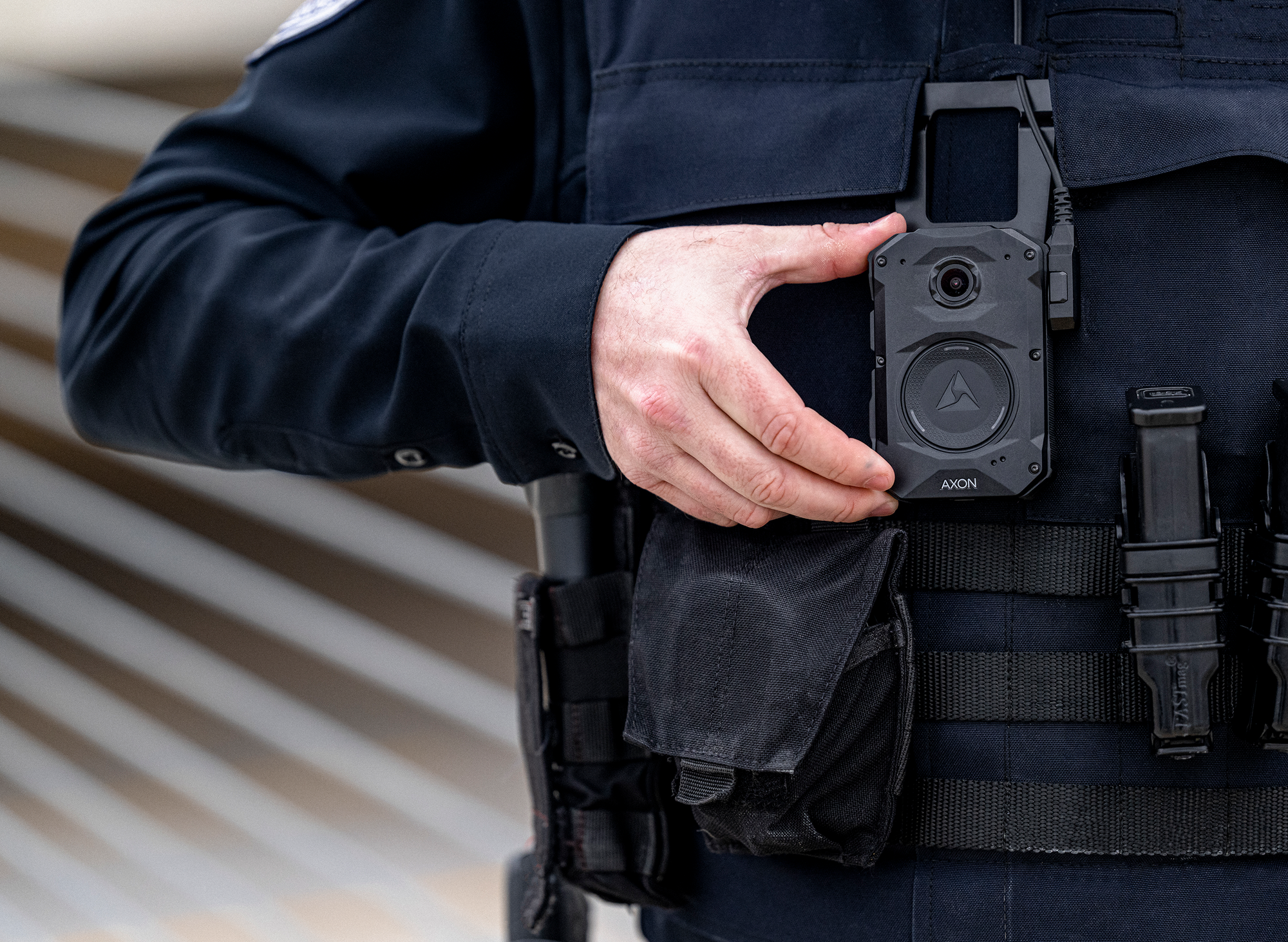
Whether it’s a gunshot audibly activating a BWC to begin recording or drawing a weapon doing the same thing, Axon’s BWC product ensures officers are recording more of their work, driving enhanced accountability and transparency. While one may read this and think “do officers really want this?” The answer is a resounding yes. The vast, vast majority of officers are just trying to safely do their jobs. Despite this, they deal with false accusations constantly, with the AB4 serving as a vital evidence collector and conduit into the rest of the Axon Ecosystem (more later). Now they simply record what happened instead of recounting it in the future. This way, review boards and judges don’t need to subjectively assess a recounting, they can actually see what happened. This was the second problem Axon solved after Tasers, and it now boasts a commanding 85% market share in major U.S. cities. As we’ll see throughout the software section, Axon has worked hard to layer in several add-ons that extend the utility lead this product enjoys over its peers.
The efficacy of this hard work and its integrated sensor, hardware and software network means $1 invested in AB4 from a police department saves them $4 on average via lower non-compliance and legal costs as well as faster, more efficient response and resource deployment.
2d. Connected Devices – Non-Drone Platform Solutions
The rest is for paid subscribers. It includes detailed commentary on the rest of the large product suite, growth opportunities, risks, financials, modeling and my conclusion.
If you'd like to read those sections, enjoy full earnings reviews on 40+ companies this season, track my portfolio/performance and join the Discord community, you can access 25% annual discounts below.