

Earnings season kicks back off next week. Taiwan Semiconductor and Netflix earnings reviews will come Thursday. Big bank credit data will come Saturday. Excited for the fundamental, company-specific news flow to pick back up again. I’ll have my earnings season preview published before my first holding reports. I will also be ready to share preliminary thoughts stemming from my Rocket Lab Deep Dive research next week.
Table of Contents
1. Amazon (AMZN) – Jassy Shareholder Letter
Robots:
- Robots continue to provide the most promising future efficiency tailwind for their fulfillment business. They now have over 1 million in circulation.
Rural Fulfillment:
- Their investments in rural fulfillment are bearing fruit. Same-day customers in rural areas rose by 2X Y/Y during 2025. They plan to keep building on this process with more investing this year.
Leo (Project Kuiper):
- 200 low Earth orbit satellites in circulation with “a few thousand more” coming in the next couple years.
- Delta Air Lines tapped Amazon to power its Wi-Fi. This will start in 2026 and scale to 500 planes by 2028. Delta joins other big wins including AT&T, Vodafone, NASA, JetBlue and more.
More on Fulfillment:
- Prime Air (drone delivery) “now has a design that will scale.” They expect to be serving 30M customers by the end of 2026. Goal to deliver within 30 minutes for some deliveries and reach 500M drone-delivered packages overall by 2030.
- “Amazon Now” can deliver thousands of items within 20 minutes. Amazon Now orders are growing 25% M/M and Prime members triple their shopper frequency once they begin to use the service. They’re now expanding beyond India and the UAE (launch nations) to the USA and Europe.
- Amazon Now and Prime Air have proven complementary. Drones use Now’s capacity to power the service and enhance rapid fulfillment assortment.
AI Scale:
- Jassy remains confident in AI CapEx returns and margins.
- AI revenue run rate is now up to $15B for Q1 2026 vs. “multi-billion” Y/Y.
- Customers are picking AWS for their breadth of tools, because most of their apps and data are already in AWS (lower inference latency) and because of what it views as best-in-class security and performance.
Chips:
- Amazon had two customers request its entire Graviton capacity for 2026. They obviously couldn’t say yes, but it’s a great sign for strong demand. This strong demand continues to be powered by superior price performance vs. Intel CPUs.
- Its Trainium2 AI accelerator is on a similar path, as it delivers price advantages vs. “comparable GPUs” and is “largely sold out.” Trainium3 is also “nearly fully subscribed.”
- Trainium4 will come out in 18 months with a “significant chunk” already reserved.
- Chip revenue run rate is up to $20B and would be closer to $50B if they were selling chips and racks outside of the AWS environment. They may choose to do that in the future.
- They expect vertical integration from Graviton and Trainium to save them billions in CapEx down the road and translate into material long-term operating leverage.
CapEx:
- When demand for AWS capacity grows, they have to spend. If demand is growing sharply enough, that will lead to heavy near-term FCF pressure. They’re happy to make this concession, as they’re adamant about strong overall returns. Most of the capacity from 2026 CapEx has already been claimed and will be monetized throughout 2027 and 2028. The spending continues to be tied to near-term demand signals.
- They have large unannounced compute deals.
More Notes:
- Amazon overhauled the inference engine for Bedrock with 40 engineers in 76 days. This is powering the product and facilitated a near 2x in M/M traffic growth.
- Bedrock is Amazon’s fully managed environment for using a giant roster of foundational models to build applications. It offers the latest and greatest products to various partners and its own foundational model too.
- The Alexa upgrade is leading to significant engagement gains as hoped for.
- Amazon will carry Eli Lilly’s new weight loss pill and will offer same-day delivery.
2. ServiceNow (NOW) – Product Announcement
A few highlights from new ServiceNow analyst notes (and for several other companies) were shared in the Discord during the week. If you’re a Max subscriber, you have access. Go join.
ServiceNow made a major product platform announcement that more natively and holistically adds AI as a default throughout its product suite. This launch pushes ServiceNow closer to their vision of being the unifier of AI tools and orchestrator of agents.
The launch features two things. First, it combines imperative AI services under one roof. It offers its front-end service bot (EmployeeWorks), cohesive access to data across a wide array of sources and types via Workflow Data Fabric, core workflow automation tools and unified agentic observability through its AI Control Tower. Additionally, this also incorporates something called Context Engine. This takes advantage of the billions of workflows and trillions of transactions in the NOW ecosystem to season agentic systems with incremental information that enhances outcomes and efficiency. This pulls directly from NOW’s Service Graph, Knowledge Graph and data systems. It also gives a decision history profile for each agent to track performance and optimize.
Rather than piecing together a web of disparate software and allocating finite developer resources to build these tools internally, NOW offers ubiquitous integrations that can unify and automate disparate governance and identity frameworks. This affordably expedites time-to-market on AI agents and applications, while allowing customers to focus on their highest-value tasks.
The second important item this launch includes is an opening of the NOW ecosystem. Next week, ServiceNow will introduce a software developer kit (SDK) so “developers can build with any tool they already use.” This includes popular coding agents from Claude, OpenAI, Windsurf, Cursor and others, and incorporates seamless processes and guardrails for adding these projects to NOW’s AI ecosystem. If customers want to build these agents on NOW’s platform, they easily can with Agent Studio (low code) and Build Agent (more tool rich for developers).
If they want to bring them to the platform post-building in minutes, they now can through “Build Agent Skills.” Again… This flexes one of the core ServiceNow AI strengths: Interoperability and seamless 3P tool onboarding thanks to omnipresent and thoughtfully built integrations with major industry players.
Rather than building and housing apps, databases and models across siloed systems… customers can use ServiceNow as the overarching harmonizer. They get a full view of all AI tools in action and all the support they need under one roof, amplifying the strengths NOW has long enjoyed as a point solution-displacing platform.
- The launch will include a “tiered offer model” to cater to small and giant customers.
- Mid-size enterprises will get access to the Enterprise Service Management (ESM) package. This combines IT, HR, legal, finance, procurement and operational services with NOW’s latest and greatest AI innovation.
- As always, NOW’s model agnostic approach means these developers can use virtually any popular AI tool they want within ServiceNow.
3. Meta (META) – New Model (Finally)
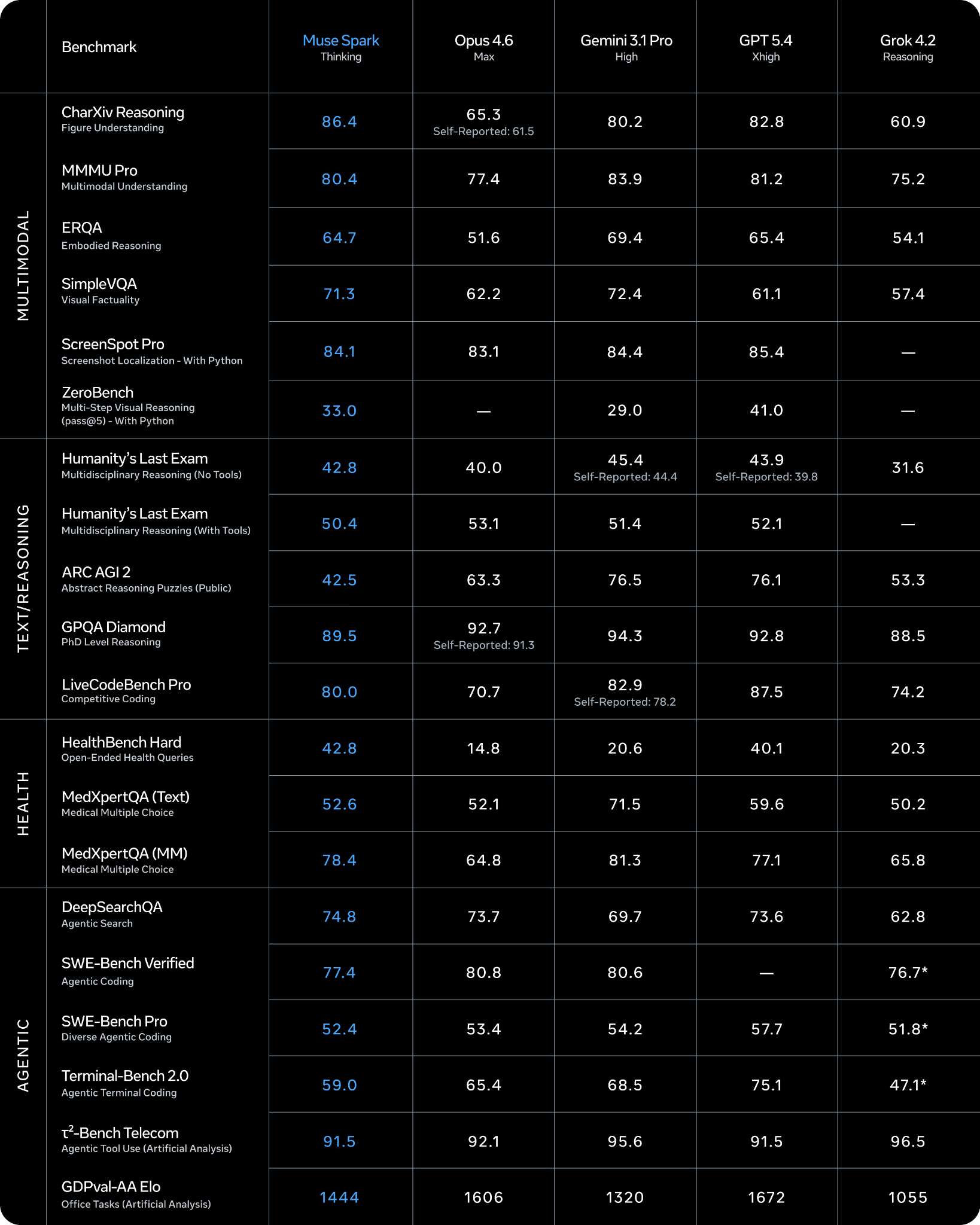
Meta released its new "Muse" family of models this week as the Superintelligence team's "first milestone." The first product within the family is called "Spark," with "competitive performance in perception, reasoning, health and agentic tasks." It's still behind in other areas like long horizon agentic systems and coding, but more models are on the way to close these gaps.
It will not be considered the best model in the world, but Meta doesn't need to build the best model. They already own all the distribution. All they need to do is build a good enough model to keep driving engagement trends higher. They don't need to convince consumers to change behaviors or app consumption patterns. They just need to keep those already-won users happy. That's what will power their core business and fund the entirely new experiences enabled by AI that they've talked about for a while -- including Meta AI as the first of many launches.
After the delay last month, it's good to see Meta unveiling this just a few weeks later with solid scores. This is especially true, considering Zuckerberg has bluntly called this model "good" with expectations of building great models after this one came out. They needed to walk before they could run, and this is good walking execution.
So again... it's not amazing at everything. More work to do. But getting there! Important first major launch for that expensive new team. I continue to think they're in much better AI shape than markets seem to currently believe.
4. Anthropic Product News
Anthropic's new model (Claude Mythos) will be released to only 40 companies for them to handle security vulnerabilities before a broader launch. This list of companies includes mega-cap tech names, JP Morgan, CrowdStrike, Palo Alto, Cisco and about 30 unnamed organizations. Rival OpenAI says this decision from Anthropic is because they don't have enough compute and the security scare is a marketing ploy.
I would have loved to see Zscaler included in this list, but again we don’t know most of the companies that are part of it. Furthermore, I'd be more worried if they were left out and Cloudflare + Netskope were included, but that isn't the case. Those are the two public and scaled direct competitors I worry about most in terms of innovation and market share for Zscaler.
5. Headlines & Macro
Shopify introduced its AI toolkit to manage stores with coding agents from Claude, OpenAI, Cursor and more.
Three more higher-ups at The Trade Desk left the company this week. Those leaving include Chief Marketing Officer and EVP Ian Colley, who has been with the company for 7 years. He is "pursuing an exciting new opportunity." Anna Sayre was promoted to replace him.
Nu will build a new HQ in Abu Dhabi. This is probably a good indicator of future expansion into the UAE and potentially other parts of the Middle East.
Jefferies upgraded Mercado Libre to buy due to runway and investment ROI optimism.
Uber added ACE Hardware to its U.S. marketplace.
Rubrik was named a preferred cybersecurity provider for the American Hospital Association (AHA) and its 5,000 member hospitals.
CrowdStrike boosted its stock buyback by $500M.
Consumer & Employment Data:
- The Institute for Supply Management (ISM) Non-Manufacturing Employment Index for March was 45.2 vs. 51 expected and 51.8 last month.
- Initial Jobless Claims were 219K vs. 210K expected and 203K last report.
Output Data:
- Durable Goods Orders M/M for February fell by 1.4% vs. a 1.1% fall expected and a 0.5% fall last month.
- Core Durable Goods Orders M/M for February rose by 0.8% vs. 0.5% expected and 0.3% last month.
- The ISM Non-Manufacturing Purchasing Managers Index (PMI) for March was 54.0 vs. 54.9 expected and 56.1 last month.
- The latest GDP reading for Q4 came in at 0.5% vs. 0.7% expected and 4.4% last quarter.
Inflation Data:
- The ISM Non-Manufacturing Prices Index for March was 70.7 vs. 67 expected and 63 last month.
- The Core Personal Consumption Expenditures (PCE) Index M/M for February rose by 0.4% as expected and unchanged compared to January.
- The PCE Index M/M for February rose by 0.4% as expected and compared to 0.3% in January.