

Table of Contents
a. AMD 101
AMD designs CPUs and GPUs, offers software and provides connectivity equipment for a wide array of cloud and enterprise clients. If there’s one thing the semiconductor industry loves, it’s constantly changing the names of products with a swarm of acronyms for us to juggle. What matters? AMD’s positioning within these areas and how it’s integrating them with its rack scale data center offering called Helios.
- Rack Scale is a data center blueprint that treats a server rack as a compute building block rather than the individual servers. Rack scale enables larger, more efficient connections between GPUs to turbocharge compute performance, density and efficiency.
- Taiwan Semi manufactures the chips that AMD designs.
GPU: Graphics Processing Unit. This is an electronic circuit used to process information and data. The accelerated compute needed for GenAI apps and models pulls from next-gen GPUs. AMD leadership believes its "MI" series GPUs compete very formidably across memory and bandwidth with Nvidia. They’re enjoying some nice momentum and market share in this arena, but Nvidia is still considered the performance leader by most.
- MI series GPUs are part of the "Instinct" product family.
CPU: Central Processing Unit. This is a different type of electronic circuit that carries out assignments and data processing. CPUs fall in the general compute bucket. General compute CPUs are still optimal for static, step-series and instruction-based tasks. They’re also much cheaper than deploying next-gen GPUs when they can work for the specific use case.
- AMD's family of data center CPUs is called EPYC. The latest iteration of EPYC is called Turin, with Venice coming soon.
- Its desktop and gaming CPUs are called Ryzen.
- AMD and Intel are the big boys in this market, with AMD consistently taking market share over the last several years.
More to Know:
- NPU: Neural Processing Unit: Used for AI-enabled personal computers (PCs).
- Data Processing Units (DPUs) (or Network Interface Cards (NICs)): High-performance compute accelerators that assume some of the work from generalist CPUs to allow those CPUs to focus on main tasks.
- TOPS: Tera Operations Per Second. This measures NPU performance (more TOPS being better). TOPS superiority is imperative for running Copilots and GenAI apps on PCs with optimal latency and model performance.
b. Key Points
- 70%+ Y/Y CPU growth and 100%+ Y/Y GPU growth.
- Helios is enjoying better-than-expected demand.
- Raised multi-year data center market growth expectations.
- 80%+ normalized Y/Y EPS growth.
c. Demand
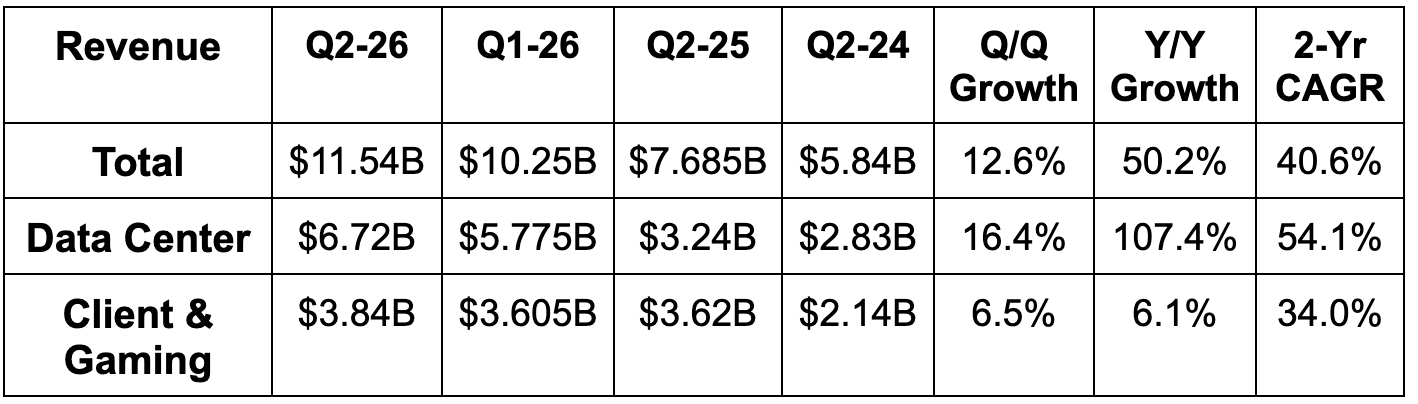
- Beat revenue estimate by 2% & beat guidance by 2.8%.
- Beat data center revenue estimate by 2.5%.
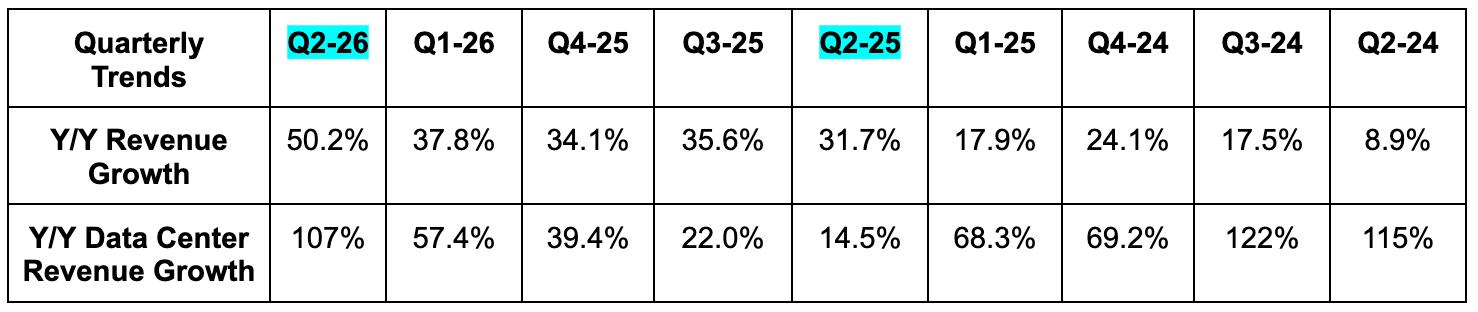
- On the CPU side, EPYC product revenue rose by more than 70% Y/Y.
- On the GPU side, Instinct product revenue "more than doubled" Y/Y. This was largely related to strong MI350 demand.
- Beat client revenue estimate by 1.8%.
- Missed gaming revenue estimate by 1.4%.
- Beat embedded revenue estimate by 1.8%.
d. Profits & Margins
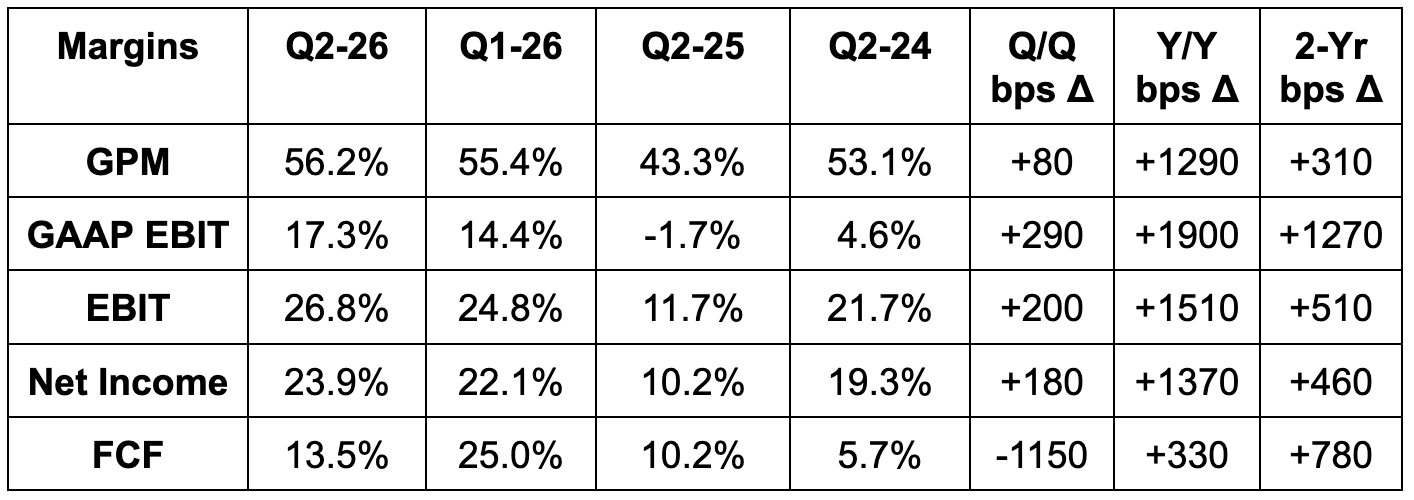
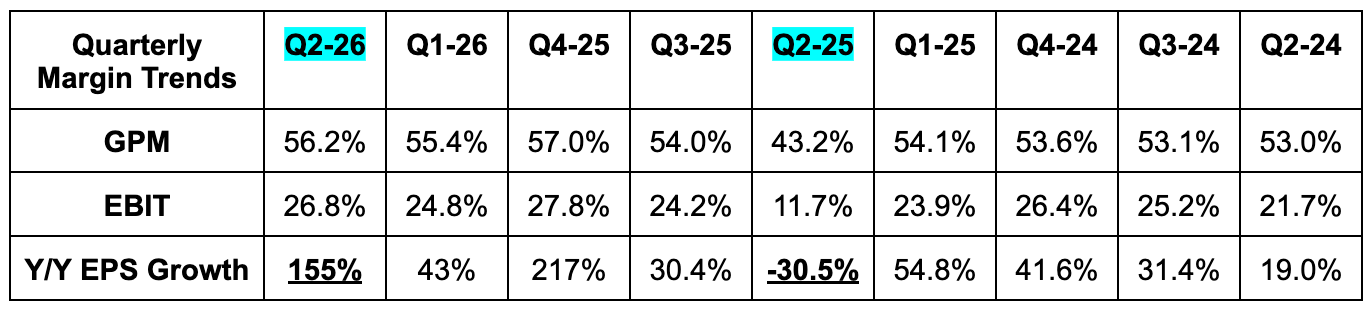
- AMD lapped an $800M inventory charge from last year that was included in non-GAAP margins. This made Y/Y comparisons easier.
- Beat 56% GPM estimate & identical guidance by 20 basis points (bps; 1 basis point = 0.01%)
- GPM got a lot of help from fantastic CPU strength and overall data center business mix shift.
- Beat EBIT estimate by 3.1% & beat guidance by 4.1%.
- Operating expenses rose by 40% Y/Y.
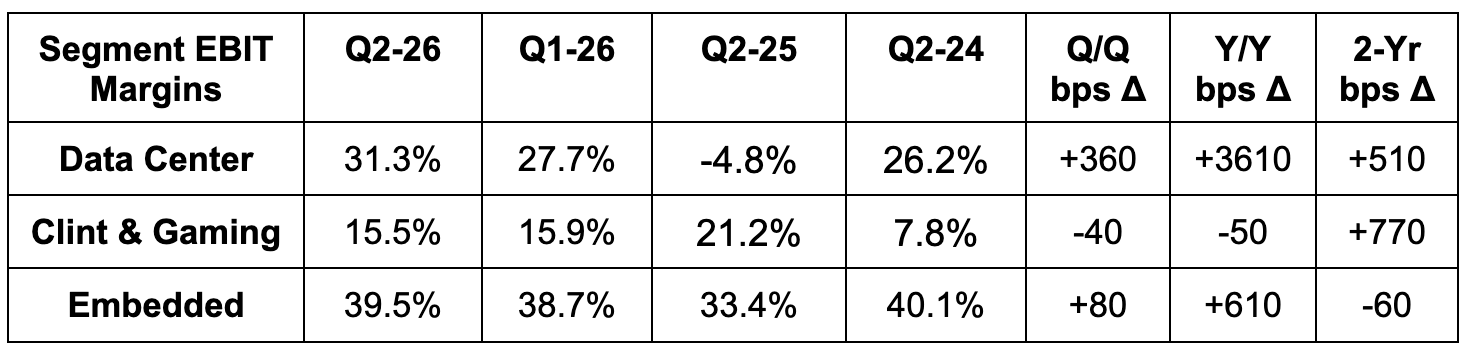
- Embedded segment Y/Y EBIT leverage was driven by stronger revenue growth.
- Client segment EBIT margin on its own fell from 21% to 15% Y/Y via "go-to-market activity investments and an expanding product roadmap.”
- Beat $1.61 EPS estimate by $0.05 & beat guidance by $0.07. EPS growth was 82% instead of 155% when excluding the aforementioned inventory charge from last year.
- Missed FCF estimates by 21%.
e. Balance Sheet
- $13B cash & equivalents.
- $2.35B debt.
- 0.5% Y/Y dilution.
- Inventory rose by 27% Y/Y.