

Table of Contents
Over the next several weeks, subscribers will get 40+ earnings reviews, ongoing fundamental news coverage and real-time updates of my own portfolio/performance.
They've already gotten ServiceNow, Alphabet, Netflix and Taiwan Semi reviews. Many more are coming next week.
We are running an annual plan discount to give you access (and the Discord room) to all of this for less. Lock in your lower rate below:
a. Key points
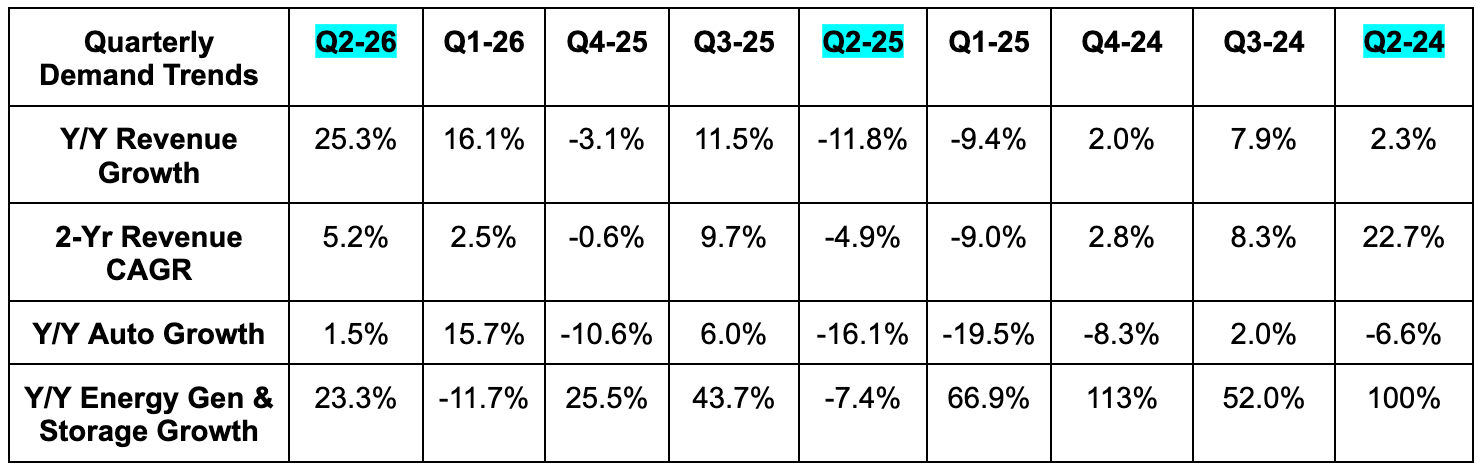
- Auto business returns to solid Y/Y growth.
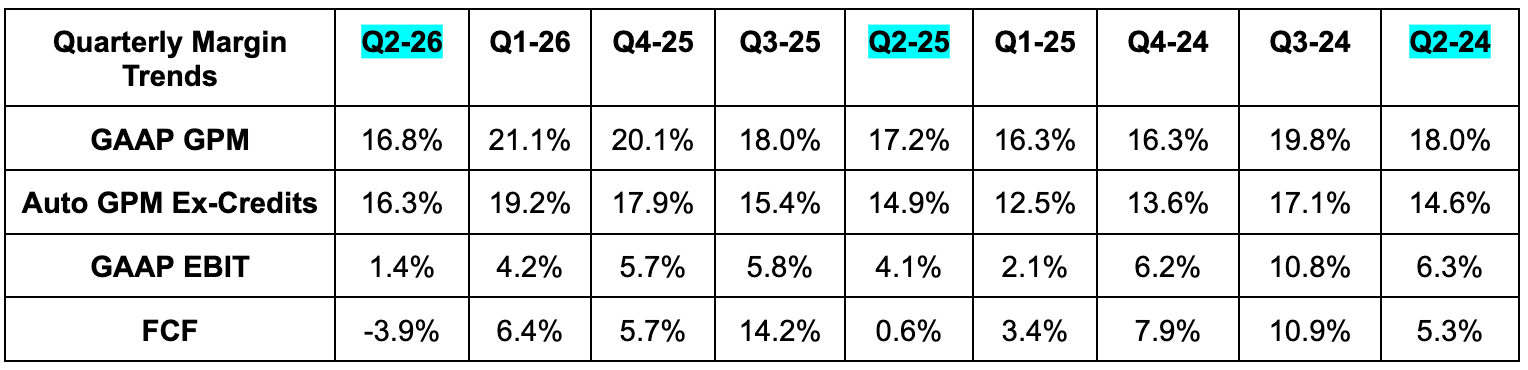
- Margins are pressured by a menu of current headwinds.
- Cybercab production is underway.
- Challenges tied to Optimus scaling were a focus point on the call.
b. Demand
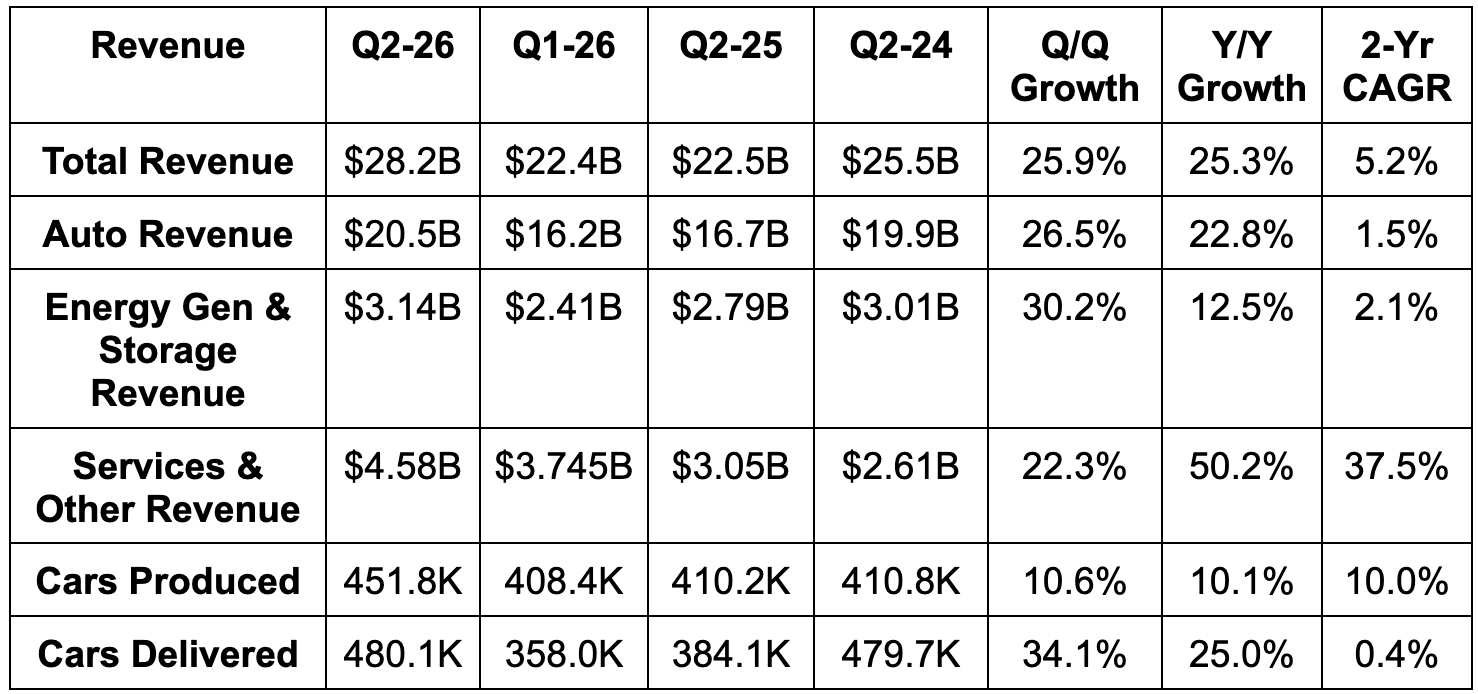
- Beat revenue estimates by 7%.
- Beat auto revenue estimates by 10.7%.
- Missed energy generation and storage revenue estimates by 16.6%.
- Beat services & other revenue estimates by 23%.
c. Profits & Margins
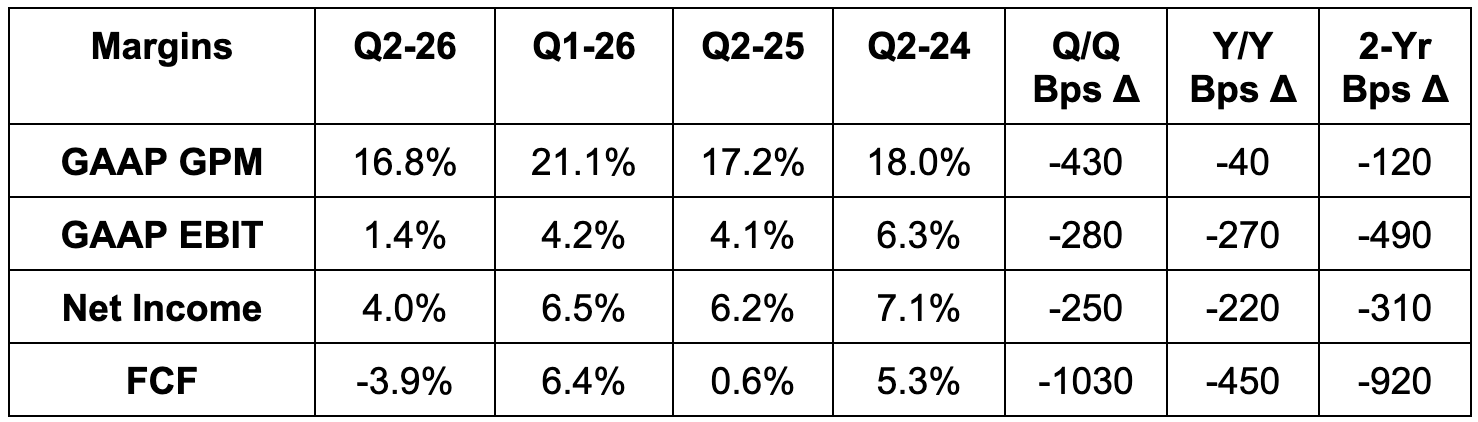
- Missed 19.4% GAAP GPM estimate by 260 basis points (bps; 1 basis point = 0.01%).
- Its 16.9% auto GPM missed 19.5% margin estimates while its 16.3% auto GPM ex-credits missed 18.4% margin estimates.
- Missed $1.4B EBIT estimates by $1B.
- Missed $0.50 EPS estimates by $0.17.
- Beat -$3.7B FCF estimates by $2.6B. CapEx was $1B lower than expected.
Auto GPM ex-credits was boosted last quarter by a $230M warranty benefit alongside lighter tariffs. Those tailwinds did not recur during the quarter. Excluding that help, this margin was stable Q/Q. For the energy business, another one-time $240M boost is why GPM fell from 39.5% to 20.4%. At the same time it also fell from around 30% to around 20% Y/Y. The business and deployments are very lumpy and prone to timing on a quarterly basis. On a trailing 12-month basis, the segment’s margin slightly ticked up from 28.9% to 29.4% Y/Y.
At the company level and adding to current margin pressure, commodity inflation and interest rates are current headwinds in addition to aggressive investing in AI. Net income margin pressure was more modest than operating income due to a $1B mark-to-market equity gain from its SpaceX stake.
Sign up for Nerd Max and join the Discord for faster news, investor collaboration, portfolio management notes and other analyst research.
d. Balance Sheet
- $43.5B cash & equivalents.
- $9.3B debt. They are potentially looking to raise another 30 billion in new debt to fund more AI investments.
- -6% Y/Y inventory growth.
- 0.6% Y/Y dilution.
e. Guidance & Valuation
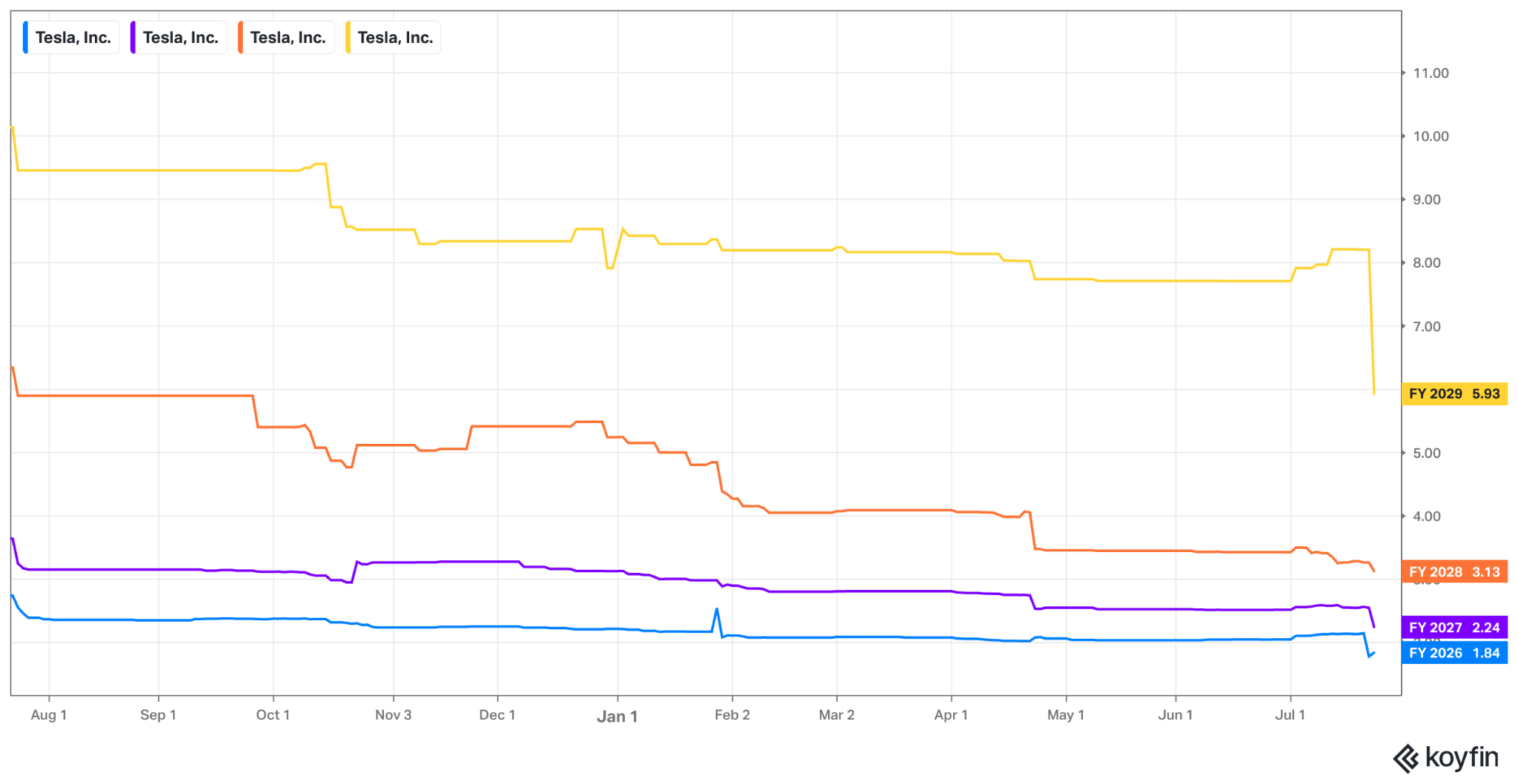
Tesla continues to expect $25B+ in 2026 CapEx and more CapEx growth for the next few years. They plan to add capacity as quickly as possible, without worrying (for now) about optimal processes and efficiency associated with the deployments. With FCF this quarter negative, that will mean operating cash flow growth needs to pick up some significant steam if Tesla is going to avoid a few consecutive years of meaningful cash burn. As of right now, Wall Street doesn’t expect FCF again until 2029.
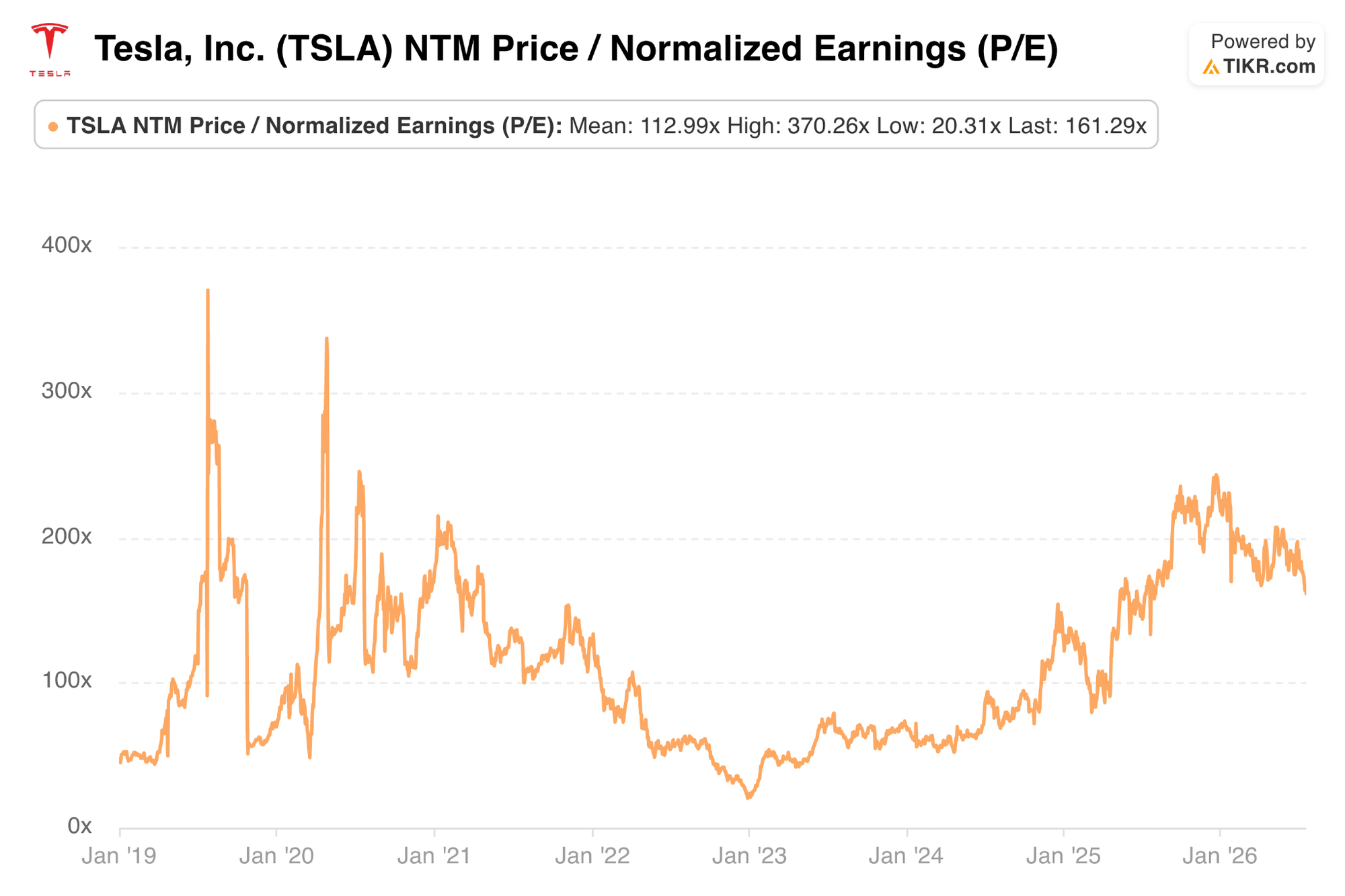
Tesla trades for 160x forward EPS. EPS is expected to compound at a roughly 20% clip over the next two years.
f. Call & Release
Core Auto Demand:
Q2 deliveries set a new company record with several countries also realizing new quarterly highs for this metric. A lot of this strength is thanks to the “best-selling” Model Y, which they launched a stretched-out version of in the USA to support overall demand. Their backlog is actually back to all time highs as well, so leadership is pushing ahead with maximum production to meet this opportunity. Hopefully that means Tesla’s quarterly auto revenue is ready to set several new highs in the coming quarters. That would go a long way in better supporting its valuation.
Going back to battery manufacturing capacity, their Texas Megafactory is gearing up to grow production while the planned Berlin 4680 battery cell facility is now under construction. Both will help alleviate Tesla’s most pressing shortage. They’re also enhancing raw material refining and production footprints in anticipation of these new capabilities. Vertical integration is what makes Tesla’s EV business more profitable than any other in the world. It’s why they’re less reliant on a web of vendors to provide vehicle parts and a big reason why they’ve been able to scale with operating leverage. This battery initiative simply fortifies that equation.
- Supply chain collaboration for electronic components and batteries has become an increasingly important way to ensure those two things don’t turn into bottlenecks. They are well on their way to a lot more internal battery production (more later), but are still reliant on partners to fill current needs and future needs.
- Full Self Driving (FSD) software has also turned into a big selling point for customers, with some even coming to Tesla specifically for the software with no material preference on which car they get with it.
Full Self Driving (FSD) Software Progress Report:
The new FSD iteration delivered a record for net new subscriptions and North American attach rate overall. They’re now up to 1.5M paid customers compared to 1.1M as of Q4 2025. 55% of deliveries to this important market during the quarter included the margin-rich software add-on, while approvals in the Netherlands, Denmark, Belgium and more countries should jump-start many more adoption curves across the globe. Everywhere Tesla has FSD approval, auto demand is better and they fully expect to secure this seemingly important green light in more places in the coming quarters.
In terms of regulatory updates, Tesla is pleased with the National Highway Traffic Safety Administration (NHTSA) shifting to a performance-based approach to autonomous vehicle regulation and safety. They think this shows an open-mindedness and willingness to regulate without such a rigid and static point of view. Musk was asked if he thinks Tesla needs more regulatory wins like these to more meaningfully accelerate their robotaxi proliferation, and he quickly answered no.
- Tesla began upgrading U.S. and South Korean customers on its AI generation 3 hardware to a version of FSD 14.
Cybercab/Robotaxi:
Their Robotaxi offering is now in 7 major U.S. cities (unsupervised in Austin, Miami, Orlando and Tampa). There are only a handful of cars in each of these markets, and because of this, leadership was asked why they don’t just push more deeply into fewer places. It’s because the regulatory climate is highly dynamic and fragmented, making it hard to just secure approvals on a whim. It’s a lengthy process, so putting it off to focus more on one market could cost them years of operations when they’re ready to expand elsewhere. That’s fair. Furthermore, they love collecting data from more places, as they push towards general autonomy and view mapping one urban area instead of several as suboptimal. I think that’s also fair.
Tesla also continues to cite public backlash caution as a reason for going more slowly than perhaps some wanted. They think they operate under a microscope and will be more criticized for any error than most peers. This, per the team, is leading them to tread very carefully and prioritize maximum safety levels over faster scaling.
- Production of the Cybercab (the vehicle they plan to scale their autonomous ride sharing business with) is now live in Texas.
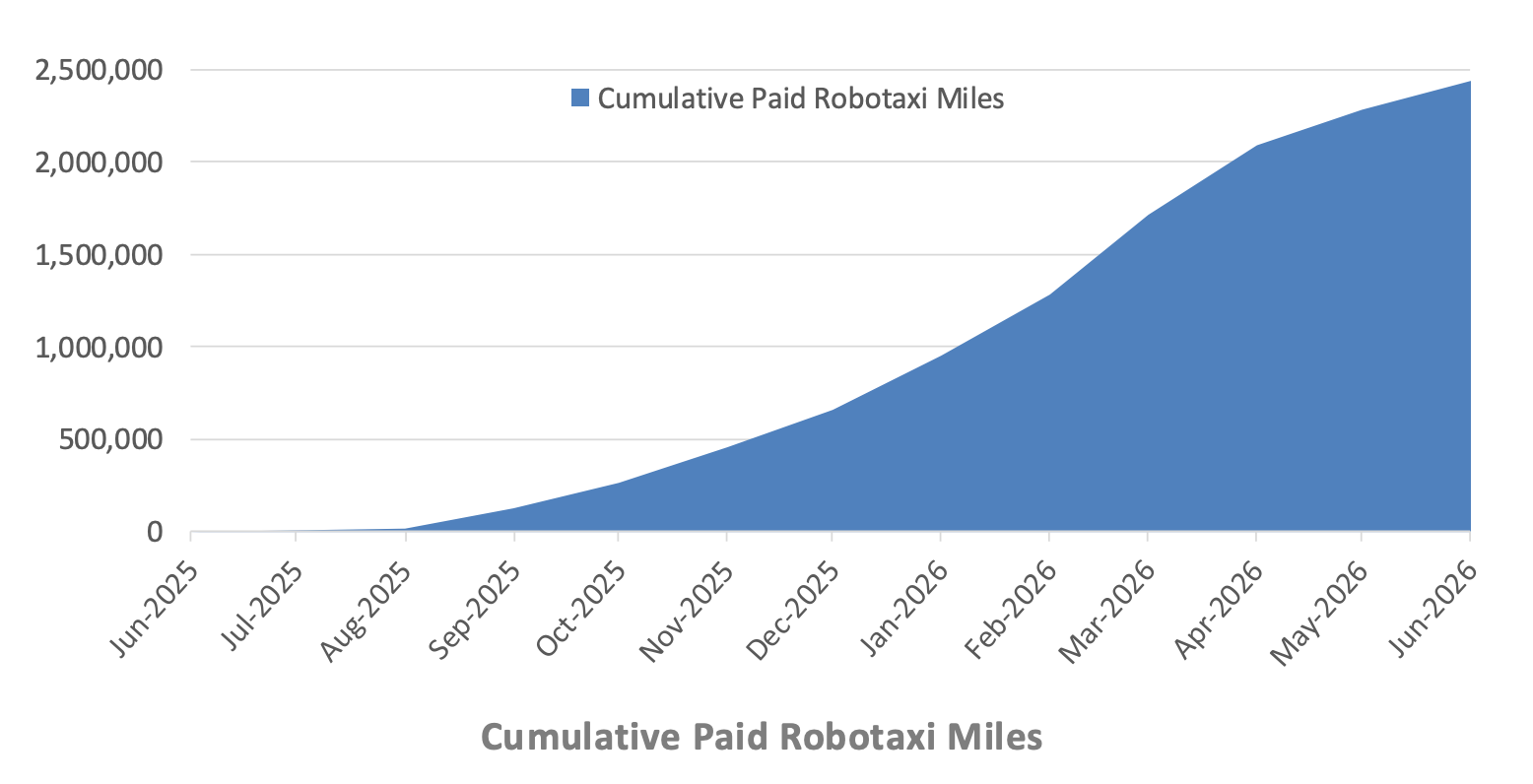
- It was notable to see the miles-driven growth curve for their robotaxi business flatten a bit. That is not supposed to happen right now. Hopefully it accelerates this current quarter as they tell investors to expect a near-term acceleration in fleet growth.
More on Auto & Services:
The semi truck is on track to begin Nevada production in 2026. This hasn’t been the top priority, with Tesla more eager to ramp Model Y and Cybertruck capacity over the last few quarters. That is now changing, as the company approaches testing and eventually commercial scaling for a product that is sorely needed (large trucker shortage).
- Supercharging stations rose 17% Y/Y.
Energy Generation & Storage:
- The Megapack 3 (for residential, commercial and industrial grids while the aforementioned batteries are for its cars) and Megablock (4 bundled Megapacks) are still set to begin Texas production this year.
- Its Three Phase Powerwall (residential battery system) is live in Germany and much better suited for Europe. This is expected to debut in more European nations in the coming months and deliver better product-market fit for Tesla.
- Shanghai production increases allowed Tesla to set new quarterly energy revenue records in Europe, Middle East and Africa.
- The company teased a new end-to-end solar cell production initiative.
Optimus:
Tesla is wrapping up the transition of Model S and X lines to Optimus. That will be done in a few months, which is when Tesla will begin building the first few units for testing, learning and training. Throughout the call, Musk highlighted how new and difficult of a manufacturing problem Optimus is. He usually throws these ideas into his quarterly remarks, but it was more of a central theme this time around. He also mentioned competitors with impressive demos and how those are all pre-programmed, while Optimus is gunning for general movement, with lofty goals such as matching human hand dexterity. That, alongside removal of volume production language in their shareholder letter, made me think their plans to ramp production through the end of 2026 and into 2027 could possibly be delayed a bit. I saw others arrive at similar conclusions. When the core auto business isn’t really growing on a two-year basis and isn’t taking significant market share or expanding margins, more of Tesla’s valuation is tied to speculative programs like Optimus. When cold water is poured over when the program will fully come to life (at 160x forward earnings), it’s understandable to see many expressing concerns.
Tesla is happy to work with partners on the Optimus supply chain and is collaborating with Samsung, Micron and Taiwan Semi on it as we speak. At the same time, they haven’t found companies for the vast majority of their Optimus needs, and so are building most of it themselves. That’s a big reason why this product could likely see more delays over time. It’s very hard to bring something this new and different to market. It’s even harder to do so while creating most of the supply chain yourself.
- Tesla plans to get even more vertically integrated between the Optimus version 3 launch and Optimus 4.
AI Hardware Footprint:
Compute is a prerequisite to any successful Optimus, Robotaxi or other innovative AI buildouts to come. They’re sprinting full speed ahead on adding capacity. They doubled their footprint at their Texas facility as Cortex 2 moved from an early ramp to more mature production. From there, its massive Texas Terafab project will soon officially set its location to take a sizable step towards construction. Tesla is already collecting needed equipment for the facility. This facility will vastly enhance Tesla’s ability to design, build and test its own AI chips, upleveling potential Optimus and robotaxi growth while enhancing the overall margin opportunity via more vertical integration.
g. Take
This quarter was better than what we’ve seen from Tesla recently, but I still don’t think we can call it great. The auto business is almost flat on a two-year basis while their margin profile struggles, the robotaxi rollout progresses slower than most want and Optimus is still far from real. There’s not much to fundamentally love about this name today. Yes, everything going well for Optimus and Robotaxi could easily mean the company performs very well over the coming years. And yes Tesla is certainly capable of delivering. But you’re already paying 160x for that potential and I think you’re pretty reliant on it all going perfectly well. That’s taking a big risk, in my opinion. I continue to think this is an amazing company that has blazed important trails and built the best electric vehicle business in the world. I just don’t think it’s a good investment. At least not right now.
Read detailed reviews on ServiceNow, Alphabet, Netflix and Taiwan Semi.