

Other reviews from this season to read:
- Mercado Libre & Datadog
- AMD & Uber
- Axon
- SoFi
- Amazon
- AppLovin & Cloudflare
- Duolingo
- Meta
- Lemonade
- Robinhood
- Alphabet
- Shopify & Coupang
- ServiceNow
- Apple
- Spotify
- Palantir
- Microsoft
- Taiwan Semi
- Netflix
- Tesla
1. The Trade Desk (TTD) – Earnings Review
Click here for an overview of The Trade Desk's business.
a. Key Points
- They continue to blame softer guidance on macro.
- Leadership is adamant that structural tailwinds remain intact.
- They are optimistic that the feud with Publicis will soon be over.
- Chief Strategy Officer Sam Jacobson is leaving for OpenAI.
b. Demand
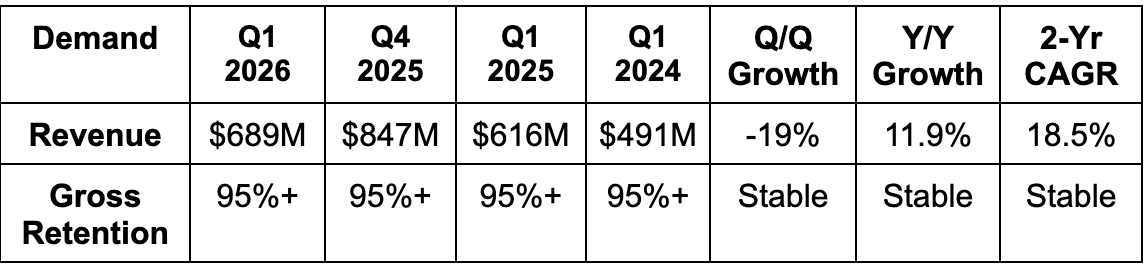
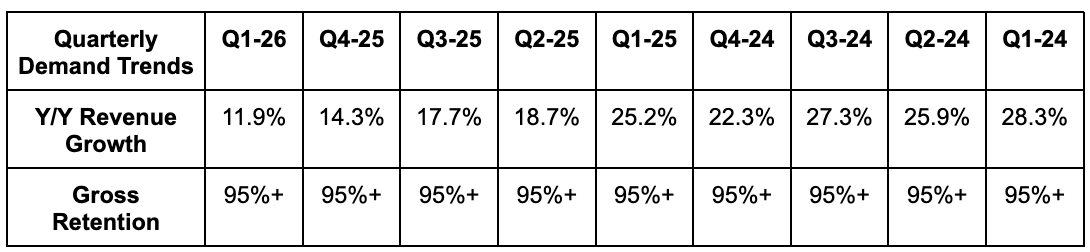
The Trade Desk beat revenue estimates by 1.5% & beat its “at least” revenue guidance by 1.6%.
c. Profits & Margins
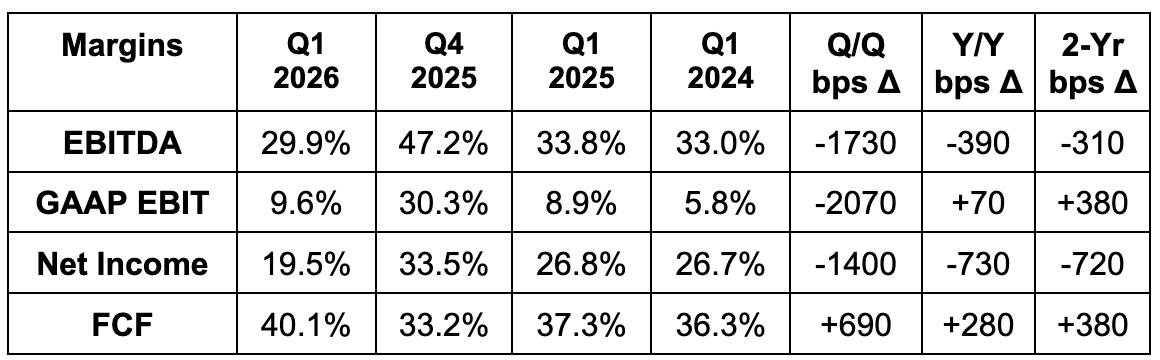
- Beat EBITDA estimate by 4.9% & beat guide by 5.1%.
- OpEx grew by 18% Y/Y to support platform-level innovation.
- Missed $0.32 EPS estimate by $0.04.
- EPS fell by 15% Y/Y.
d. Balance Sheet
- $1.4B cash & equivalents.
- No debt.
- Diluted share count fell by 5% Y/Y.
- Very pretty balance sheet.
e. Guidance & Valuation
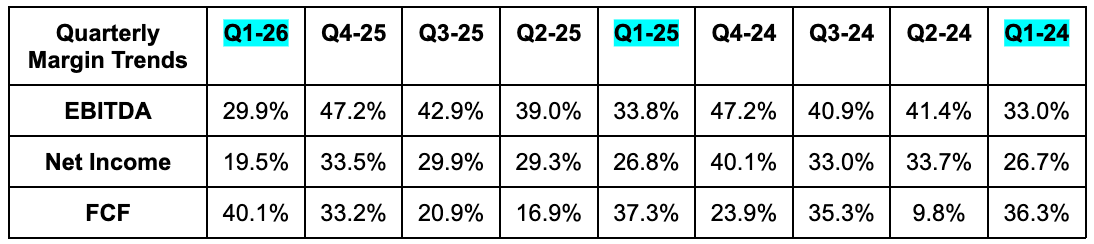
For the full year, they continue to expect a 40%+ EBITDA margin, which should be roughly flat Y/Y. That was good to hear amid the 3 points of Y/Y margin contraction seen during Q1. They will get cost leverage from headcount to make up for upcoming platform-level investments. The plan is to grow their employee base at a slower pace than the business this year.
f. Call & Release
Weak Macro:
The Trade Desk blamed Macro for yet another disappointing performance vs. consensus – despite lowered expectations. It's interesting… companies that are fundamentally weaker will routinely blame Macro for their shortcomings more than direct competitors that magically are seeing more constructive backdrops. I realize that The Trade Desk caters more to global brands and these are more susceptible to tariff headwinds and geopolitical concerns. At the same time, AppLovin, Meta, Google, and Amazon all have large clients in the verticals TTD is calling out as especially weak. They are not seeing that weakness in the same light, which leads me to believe that this is not macro, but the company's own blunders continue to hold them back. Programmatic advertising remains an attractive secular growth story, and 2026 includes midterm election tailwinds that have historically led to easy year-over-year accelerations at this company. Last year, we were told that growth acceleration would happen in 2026. At this point, it's clear that's not going to come remotely close to happening. They can blame Macro headwinds that pop up, but I'm really just not buying it.
I think their mess of a Kokai platform rollout, their constant stream of organizational and strategic changes, their very public battles with large agencies accusing them of unfair take rates, their C-suite that resembles a revolving door, and intense competition from Amazon and others are the reasons for their disappointing results. If Macro was amazing, their consumer packaged goods and other struggling verticals would obviously be growing faster than they are right now. But if this company was in healthier and better shape, they would not be so seemingly fragile; they'd be more capable of overcoming these things as they pop up. They clearly are not.
In the past, The Trade Desk used periods of chaotic Macro to motivate more customers to modernize practices within targeting and measurement more rapidly, which is great for their business. These have been the periods where TTD had taken the most land and distanced itself from the competition. This year, for the first time since going public, it doesn't look like it will outgrow the market by more than a couple points. The market share gains are greatly slowing (almost flattening), which I find concerning. Still, they're adamant that they will revert to outsized growth even though it's very hard to tell from this quarter and forward guidance.
Generally speaking, we got the same quarterly spiel from Jeff Green about how he's more optimistic than ever, and the company's in a better position than it's ever been. They see these “Macro headwinds” as temporary, and think the structural ingredients underpinning the TTD business model are still firmly intact. Green continued to see connected TV as in its early innings with audio advertising quickly ramping, retail media also quickly ramping, and Agentic Search creating exciting new opportunities for the company (more later). All I will say is, we get these sermons each quarter, and they become much harder to get excited about every 90 days. Better results can fix that, but they’re not yet coming.
State of the Global Ad Market – Supply Side:
Green spent a lot of his time dissecting industry developments across various parts of the ecosystem, starting with the supply side. Inventory rose during 2025 at a rate faster than the company's ever seen. Titans like Netflix, choosing to greatly enhance ad load along with new partnerships with Spotify, helped create a lot more impressions for Trade Desk's buy-side clients. That naturally creates a buyer's market and allows its large brand customers to get more picky and more selective, both on impression, appeal, and price.
Trade Desk did acknowledge the fact that some publishers are looking to "wall off" their inventory and emulate the business models that made Facebook and YouTube so unbelievably successful. Perhaps that's holding back results, even though it didn't explicitly say so. Trade Desk thinks giving buyers a full view of the open market simply provides too many substitutes for this to work for anyone besides the mega-caps. That diminishes market power enough to make walled gardens unattractive for almost everyone (per TTD).
Their relationships with Netflix, Disney and NBC were all positively discussed. Green talked about TTD outperforming for NBC during this year’s Olympic games, showing that the company can scale and meet the moment with high-quality results during the most important events on the planet. This also proves again that live sporting events are a natural fit for programmatic bidding, with targeting potential even better considering interest swings in real-time with evolving scores and results.
On the audio side, their partnership with Spotify is developing very nicely. We saw the very first signs of this showing up in financials, as audio rose from 5% to 6% of total business for the first time. Jeff Green and The Trade Desk think this is the most under-monetized surface on the internet right now. They feel like they're in pole position to capture this opportunity. We’ll see.
- As an aside, the buyer’s market note should be very good for the company's business. And again, it's hard to see that playing out in its financials.
State of the Global Ad Market – Buy-Side:
When the company talks about walled garden models not making sense for anyone except a few companies, they're talking about Meta, Google, and Amazon.
Even for these titans, TTD discussed people increasingly realizing the shortcomings of their “cheap reach” and opaque reporting the 3 companies are sometimes criticized for utilizing. They think both the demand side and supply side competitors are growing increasingly critical of standard measuring practices that favor bottom-of-funnel and last touch attribution while discrediting all the work other placements did to improve customer intent enough to convert. This growing awareness, per the company, should be a tailwind for their model. It was this quarter for a leading pharmaceutical advertiser that previously left for Amazon due to the promise of cheap reach and the zero-fee tests. They boomeranged back to TTD for better returns. They’ll grow TTD spend by 114% this year as a result. Products like Audience Unlimited, which allows customers to use TTD’s scaled based on 3P data more conveniently and affordably, was an edge here. And per Jeff Green, it should be an edge elsewhere, considering TTD represents 80% of retail market share within its customer base and Amazon is around 15%.
- It’s important to note here that all 3 of those businesses are in fantastic shape and outgrowing this company despite a much larger base. So, while TTD may continue to criticize their ways of doing things… Those ways are working. But I digress.
- Green also spoke about a cohort of buyers who were looking to more rapidly modernize ad processes with TTD, like the company usually sees during turbulent times (talked about above). That cohort is just not currently large or meaningful enough to mask the ongoing deceleration in growth despite easier comps and cyclical tailwinds kicking in.
Trending to the Open Internet?
Leadership is arguing that an increasing focus on ad returns instead of ad price (related to cheap reach conversation above) is motivating many customers to seek out the open internet through Trade Desk’s platform. More and more, brands are realizing that paying more for a placement routinely makes sense thanks to superior expected value compared to a social ad that is usually viewed for a second or two. This is making them more confident in “soon” consistently getting more of the first campaign dollars vs. walled garden giants. TTD has been talking about this for a while and they’ve been disclosing the trend of more dollars going to the open internet over the closed ecosystems as if it was already in full swing. The addition of “soon” this quarter felt like a negative change in tone, but maybe I’m reading too far into things.
JBP Momentum & Publicis:
The company's pace of joint business partnership (JBP) additions continues to notably improve quarter over quarter. They grew JBP's at a 55% Y/Y clip, including 40% Y/Y growth, excluding renewals. On the other hand, this could have gotten a temporary boost from their loud and public battles with a large agency called Publicis. As previously covered, Publicis accused Trade Desk of some pretty shady practices in terms of fee structures, and communication of those fee structures. They no longer recommend TTD to their clients, which could have pushed more of them to embrace a direct relationship with the company through JBP’s. On the bright side, that means these companies are still determined to work with TTD, despite their agency telling them not to. At the same time, this probably is a reason why growth here is so impressive.
Speaking of Publicis, Green acknowledged that the relationship remains good and dialogue between the two companies is ongoing. He hopes that the drama will be soon behind them, and thinks the media ran with the story in sensationalistic ways that didn't truly reflect how things were evolving. They had nothing more to say about this on the call when asked.
AI:
The Trade Desk is partnering with Stagwell to infuse agentic technology into ad campaigns and impression trading. This will start with automating “creation, editing and modification of campaigns,” with phase two including agentic-inspired performance optimizations. The team elaborated on the sheer number of potential campaign optimizations, overwhelming customers, and routinely fostering more complexity than value. Unlocking conversational querying of recommendations and actionable ways to deploy those data-driven recommendations should be very powerful. The company needs to work very hard on rapidly innovating as times evolve at an especially torrid pace. They do not own impressions thanks to a scaled base of customer traffic they directly house. They are in the business of convincing customers they need TTD to buy those impressions in the best way possible. There is a boatload of agentic innovation and potential disruption happening in this specific area, and TTD must use its enterprise-facing scale, talent and balance sheet to fend off these competitors and/or homegrown solutions. Partnerships like these can help.
AI Creating New Opportunities:
Search is changing. And while Alphabet will probably continue to have a dominant portion of whatever it turns into, there are other scaled alternatives emerging that are more open to working with companies like The Trade Desk. More specific prompt inputs should allow the company to understand intent and interests in a far more precise way, easily matching customers with products they want. Because there are several other LLMs vying for market share, and because they are spending so much on scaling operations, TTD is confident that they must monetize with ads. They're optimistic about capturing a lot of those deals, and should have more to share with us in this regard in the future.
Supply Side Entry?
OpenTTD is their new “central hub” of information that openly integrates with other platforms and customers. It unifies data analytics and makes it easier (on top of OpenPath) for publishers to access what they need directly from Trade Desk. The company was very intentional to again mention that they will not get into the business of yield management for publishers. That is what the supply side does, and it would create a conflict of interest if Trade Desk did that, while they were trying to optimize return on ad spend for buyers. You cannot optimize for the same thing at the same time. On the other hand, they will make it increasingly seamless for publishers that want to perform their own sell-side tasks to access this platform and rich base of information on their own. Other products like OpenAds, which provide a cleaner environment for impression auctioning without as much supply chain mess is another product that should help.
More Notes:
- Chief Strategy Officer Sam Jacobson is leaving for OpenAI. She’ll remain a board member. Yet another executive is leaving the company.
- The company is beginning to add brick-and-mortar retail media business as it starts to become more omni-channel in nature for customers like Dollar General. An ability to target shoppers in-store is interesting. They can theoretically use geofencing to know who is entering a store and what promotion they might want.
- Partnered with LinkedIn to “activate their B2B data for connected TV (CTV) monetization.”